

Market overview
The JSE All Share closed the week at 114 544.40 decreasing by -2.78%. The biggest contributing sector was the consumer staples sector, adding 3.27% while the basic materials sector decreased by 6.44% during the same period.
Looking globally, developed markets decreased by 0.28% (USD) during the week and emerging markets decreased by 2.45% (USD) during the same period.
Local events
* South Africa’s unemployment rate rose to 32.7% in Q1 2026 with 301,000 more unemployed and employment declining by 345,000, signalling labour market weakness.
* South Africa’s mining production rose 2.5% year-on-year in March 2026, as declines in key commodities weighed on overall activity, indicating sector pressure.
* South Africa will be opening its rail network to private operators across 41 routes, as Transnet targets freight volumes of 250 million tonnes by 2029, signalling improving logistics and export capacity.
* SARS is targeting R44 billion in unpaid tax debt, aiming to strengthen government finances and improve revenue collection amid fiscal pressures.
Global events
* US inflation rose to 3.8% in April 2026, driven by a 17.9% surge in energy costs, signalling persistent inflation pressures.
* US–China agricultural trade fell 65.7% to $8.4 billion in 2025 but plans to reduce tariffs and improve market access signal a potential recovery in global trade flows.
* Freight rates on the Shanghai to Gulf route surged from $980 to $4,131 per container, with trade flows falling up to 80%, highlighting rising inflation pressures.
* US manufacturing output rose 0.6% in April, the strongest gain in 14 months, driven by a 3.7% surge in motor vehicle production and AI demand, though supply disruptions pose downside risks.
Thanks to PPS Investments for the weekly Market Overview.
Financial Indicators by Sharedata.co.za
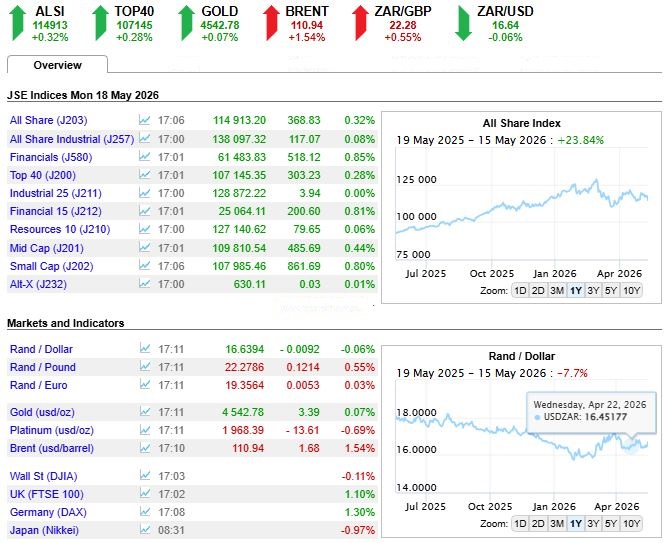
Trouble for the rand
The rand and local markets are trading weaker at the start of the new week, weighed by the protracted Iran War and forecasts of higher inflation. While the local unit has been trading in a relatively resilient range over the past few months, the range has moved higher. Read the full Businesstech article here>
Top economist shares good news about interest rates in South Africa
Investec chief economist Annabel Bishop said May is not expected to see an interest rate hike from the Reserve Bank’s Monetary Policy Committee (MPC). This is despite growing inflationary pressures stemming from the Middle East war, with the central bank expected to look through these shocks for the time being. Read the full Daily Investor article here>
Navigating financial uncertainty: reacting vs responding to global events
Global instability and geopolitical tension are real and tangible, and shaping the financial environment in which households operate. From rising geopolitical conflict to the knock-on effects of higher oil prices, global uncertainty is filtering into the everyday financial realities of South African households at an accelerating pace. Read the full IOL Personal Finance article here>
Precious metals take a pounding over Iran war and rate jitters
Precious metals stocks took a beating last week as hopes of a resolution to the Iran war and the reopening of the Strait of Hormuz receded once again – repeating a pattern witnessed numerous times over the last six weeks. Read the full Moneyweb article here>
Oil prices climb as Donald Trump signals tougher action on Iran
International benchmark Brent crude futures for July rose 1.81% to trade at $111.27 per barrel, while US West Texas Intermediate futures (WTI) for June gained 2.15% to $107.69 per barrel as investors weighed President Trump’s latest message to Iran. See the full article on MSN here>
Trump got a cold shoulder from China: financial markets in dire straits
Financial markets across the globe got some bloody noses after a ‘cold’ meeting between the United States (US) President Donald Trump and the Chinese leader President Xi Jinping. See the full analysis on IOL BUsiness Report here>
The EU will cut growth outlook, raise inflation forecast as Iran war drives ‘stagflationary shock’
The EU will downgrade its growth forecast because of the “stagflationary shock” caused by the Iran war, the bloc’s commissioner for the economy told CNBC. Read the full CNBC article here>