

Market overview
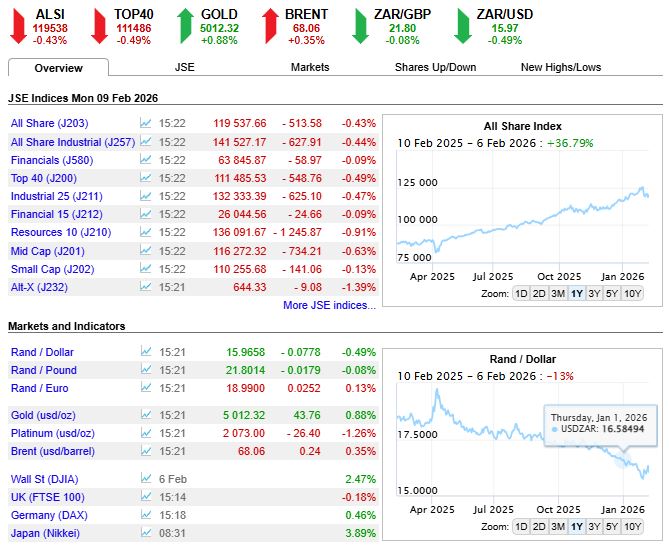
The JSE All Share closed the week at 120 051.30 increasing by 0.05%. The biggest contributing sector was the oil and gas sector, adding 6.01% while the technology sector decreased by 3.94% during the same period
Globally, developed markets increased by 0.04% (USD) during the week and emerging markets decreased by 1.40% (USD) during the same period.
Local highlights
* South Africa’s seasonally adjusted Absa Purchasing Managers’ Index (PMI) rose to 48.7 in January 2026 from 40.5 in December, which was the weakest reading since April 2020. Although signalling a fourth consecutive month of contraction in manufacturing, the pace of decline eased notably. The improvement was primarily driven by a rebound in business activity, with the relevant sub-index rising above 50 to 51.4 from 46.1 in December.
* South Africa’s gross foreign exchange reserves increased to $80.19 billion in January 2026, the largest value since records began in 1998, from $75.892 billion in the previous month. This was driven by increases in gold reserves, Special Drawing Rights (SDR) holdings, and foreign currency reserves.
Global highlights
* The ECB left interest rates unchanged at its first policy meeting of 2026, reiterating that inflation is expected to stabilize at its 2% target over the medium term. The ECB said the euro area economy remains resilient, but cautioned that the outlook remains uncertain, particularly due to global trade policy risks and ongoing geopolitical tensions
* The Bank of England kept its Bank Rate unchanged at 3.75% in February, with a narrow 5 to 4 votes, as policymakers balanced easing inflation pressures against risks from a weakening economy. Four members supported a 25-basis point cut, highlighting growing divisions within the Monetary Policy Committee.
* The University of Michigan’s consumer sentiment index increased by 0.9% to 57.3 in February 2026, marking a third consecutive monthly increase and beating market expectations of 55. Despite the improvement, sentiment remained roughly 20% below its level in January 2025.
Thanks to PPS Investments for the weekly Market Overview.
Financial indicators by Sharedata.co.za
Warning about petrol prices in South Africa
While lower petrol prices in South Africa are great news for motorists, the impact on inflation is limited because half the price goes to tax—and another tax hike may be coming. Read the full Businesstech article here>
Financial markets remain nervous: Crypto took a hiding
The equity, capital and foreign exchange markets traded nervously last week, after the big speculative sell-off of the previous Friday. Precious metals prices also remain under pressure but started to recover last Thursday, with the gold price trading again near the $5 000 per ounce level ($4 966 in late trading). Read the full IOL Business Report article here>
Gold advances near $5 000
Gold advanced, as dip-buyers returned to the market after an exceptionally volatile week for precious metals. Bullion traded either side of $5 000 an ounce, seeking a solid floor after a historic rout at the end of last month. Read the full Moneyweb article here>
Softer dollar helps gold gain more ground
Gold extended gains on Monday to trade just above the $5,000/oz level as the dollar dipped, while investors awaited a key US labour market report due later in the week to gauge the interest rate trajectory. See the full BusinessDay article here>
Which risk runs deeper: owning or avoiding emerging markets?
Emerging markets (EMs) account for more than 80% of the world’s population and more than half of its gross domestic product (GDP), but less than a tenth of typical global equity portfolios. With cheaper valuations, weaker currencies and lower correlations to developed markets, selective exposure to EMs can add diversification and resilience when it matters most. See the full article on Allan Gray here>