

Market summary
The JSE All Share closed the week at 117 748.23 increasing by 3.51%. The biggest contributing sector was the basic materials sector, adding 14.28% while the consumer discretionary sector decreased by 3.58% during the same period.
Looking globally, developed markets decreased by 1.16% (USD) during the week. Emerging markets increased by 1.24% (USD) during the same period.
Local events
• South Africa’s inflation rate slowed to 4.3% in July, driven by lower fuel and food price pressures, supporting a more favourable inflation outlook.
• South Africa’s SACCI Business Confidence Index rose to 125.4 in July, indicating improving business sentiment and confidence in the economic outlook.
• South Africa’s retail sales increased 1.6% year-on-year in June, although growth slowed from the previous month, pointing to softer consumer spending conditions.
• Business and government have launched a growth plan to create one million jobs by 2030 and accelerate economic growth through reforms in infrastructure, mining, tourism, and agriculture.
Global events
• China’s industrial production grew 4.5% in July and signalling softer economic momentum in South Africa’s largest trading partner.
• UK inflation rose to 2.9% in July, driven by higher energy and household costs, highlighting persistent inflation pressures.
• The Federal Reserve kept interest rates unchanged at 3.50%–3.75%, while signalling that inflation and energy price risks could still require further policy tightening.
• China’s retail sales growth slowed to 0.6% in July, indicating weaker consumer demand in South Africa’s largest trading partner.
Thanks to PPS Investments for the weekly Market Summary.
Financial Indicators by Sharedata.co.za
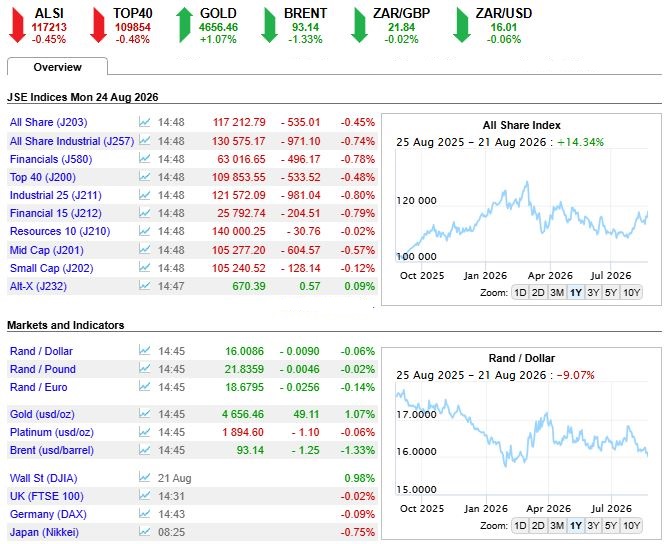
Rand breaks through R16 to the dollar
The rand broke through the critical R16/$ resistance level on Monday, touching R15.99 to the dollar for the first time in almost 6 months. While this is not a complete reversal of the pain the unit suffered due to the onset of the United States-Iran War at the end of February, it is a strong signal to markets. Read the latest news from Businesstech.co.za here>
The private sector is the only thing creating value in South Africa
The government is a net destroyer of value in South Africa due to its historic mismanagement and reliance on borrowing. In contrast, data from Codera Analytics shows the private sector has been a net creator of value in South Africa since 1995 and is the main driver of employment and GDP growth. Read the full article on Dailyinvestor.com here>
Oil prices slide as markets await Trump’s ‘most crushing’ Iran sanctions plan
Oil prices fell on Monday as investors braced for details of a US plan to isolate the Iranian economy that President Donald Trump billed as the “most crushing” financial operation ever against Tehran. REad the full IOL Business article here>
Gold advances to three-month high
Gold climbed to the highest in more than three months after the US Treasury’s bold intervention in the bond market revived concerns about a weaker dollar and pushed investors toward alternatives. REad the full Moneyweb article here>
Wall Street’s Three-Way Stress Test
The final week of August will test three of the market’s strongest convictions: that Washington can contain the economic damage from Iran, that inflation will cool without a painful intervention from the Federal Reserve, and that artificial intelligence can justify the extraordinary sums being spent on it. Read the full Marketscreener.com article here>
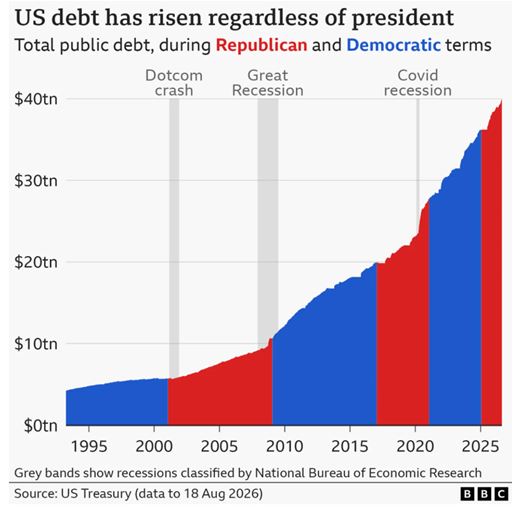
$40 trillion and counting
US total public debt has climbed relentlessly for three decades, hitting $40 trillion this week – regardless of which party held the White House. Over the past year the debt grew at an average rate of $7.91 billion per day and the total has more than doubled in the past decade from just under $20 trillion in 2016.
The chart shows three major shocks driving step-changes higher: the dotcom crash, the Great Recession and the Covid recession – with debt rising steadily under both Republican and Democratic administrations alike. It took nearly 200 years for the debt to reach its first $1 trillion back in 1981 – the next trillion, at current pace, arrives in about five months.
Article courtesy of Ninety One.