

Market Summary
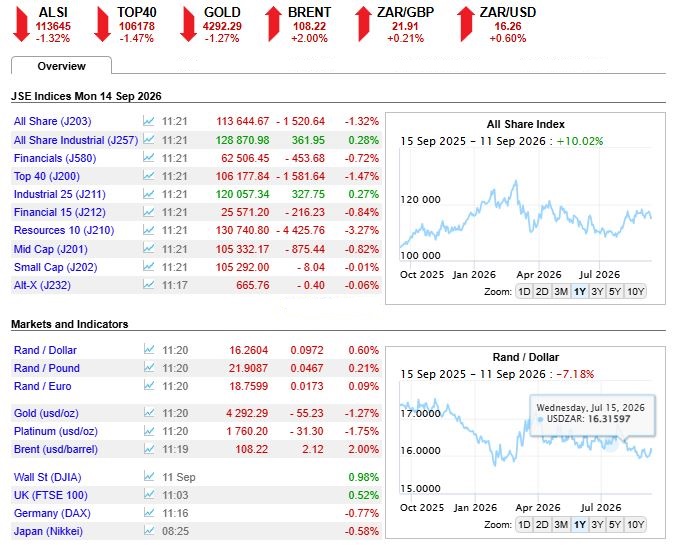
The JSE All Share Index closed the week at 115 021.64 decreasing by 1.03%. The biggest contributing sector was the oil and gas sector, adding 4.78% while the technology sector decreased by 3.75% during the same period.
Looking globally, developed markets decreased by 0.98% (USD) during the week. Emerging markets decreased by 0.23% (USD) during the same period.
Local events
• South Africa’s economy grew 0.9% year-on-year in Q2 2026, slowing from 1.9% in the previous quarter and highlighting continued challenges to economic momentum.
• South Africa recorded a current account deficit of R205.5 billion in Q2 2026, the largest since 2015, driven by higher oil import costs and a narrower trade surplus.
• South Africa’s manufacturing production grew 1.1% year-on-year in July, returning to growth after three months of contraction.
• South Africa’s mining production fell 7.5% year-on-year in July, the sharpest decline since February 2025, driven by weaker PGM, coal and iron ore output.
Global events
• The European Central Bank raised its key interest rate to 2.65%, citing persistent inflation pressures and signalling that interest rates may remain higher for longer.
• US inflation remained steady at 3.4% in August, while core inflation slowed to 2.4%, signalling easing underlying price pressures despite higher energy costs.
• China’s trade surplus widened to $119 billion in August as exports surged 25%, highlighting strong trade activity in South Africa’s largest trading partner.
• Brent crude rose above $100 per barrel after Saudi Arabia shut down a pipeline carrying 4% to 5% of global oil supply, raising inflation and energy security concerns.
Thanks to PPS INvestments for the weekly Market Summary.
Financial indicators by Sharedata.co.za
Oil price surge continues, with no end in sight: How October’s fuel prices could be affected
International oil prices climbed sharply on Monday, with Brent crude surging past the $107 mark as escalating tensions in the Middle East fuelled fears of disruptions to global energy supplies. Read the full IOL article here>
Foreign investors are pumping money into South Africa
South Africa’s bond market remains incredibly attractive to international investors, with many drawn to the strong returns and improvements in the South African environment. Read the full article in Businesstech here>
Gold steady as hot US inflation bolsters chance of rate hike
Gold steadied — after dropping for a third straight week — as hotter-than-expected US inflation data raised the chance of the Federal Reserve hiking interest rates later this week. See the full article in Moneyweb here>
AI warnings knock Nasdaq futures, pressure tech stocks
Futures tracking the Nasdaq 100 index led losses early on Monday, dragged by a selloff in AI heavyweights after top U.S. executives said development of the technology should be slowed due to safety concerns. See the full article in Marketscreener here>
ECB hikes rates to 2.5% as energy shock pushes eurozone inflation higher
The European Central Bank has raised interest rates by a quarter point, lifting its deposit rate to 2.5%, as the energy shock driven by the Iran war pushes eurozone inflation higher and forces a second hike in three months. Read the latest from Euronews here>
S&P 500 return: the last 10 years
The S&P 500 has returned 315.3%* over the past decade; averaging over 15% a year, well ahead of its long-term average of around 10%.
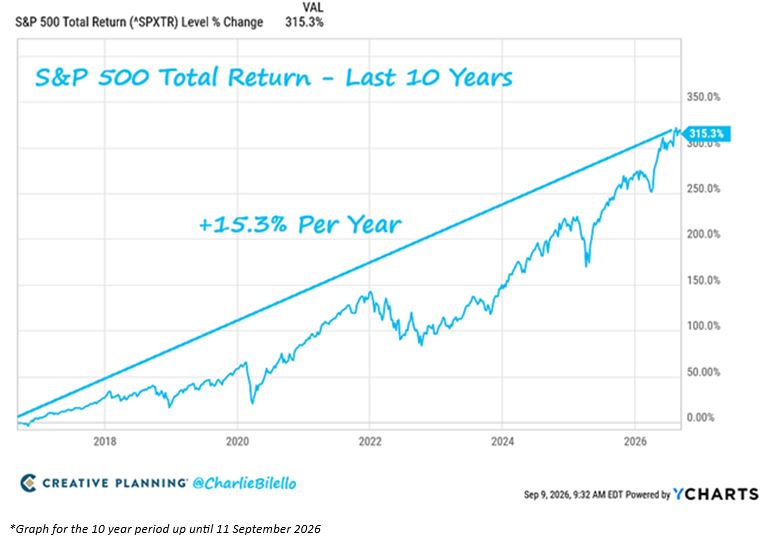
It’s been a golden run for US equity holders, but returns this far above trend rarely repeat, and it’s exactly the backdrop against which the risks below are worth weighing:
*Elevated valuations for the S&P 500,
*A prolonged war in Iran, with food and energy prices pushing higher and feeding through into inflation,
*The risk of an AI capex slowdown, or worse, a bust.
It’s also the case for looking beyond a single market that has done most of the heavy lifting for ten years running.
Thanks to Ninety One for this commentary.