

Market Overview
The JSE All Share closed the week at 110 070.30 decreasing by 4.14%. The biggest contributing sector was oil and gas, adding 5.75%, while the basic materials sector decreased by 9.42% during the same period.
Looking globally, developed markets decreased by 1.95% (USD) during the week, while emerging markets decreased by 0.35% (USD) during the same period.
Local events
* South Africa’s inflation eased to 3.0% in February 2026, the lowest level since June 2025, driven by lower fuel and food prices, with core inflation also moderating.
* South Africa’s 10-year bond yield rose to around 9%, a five-month high, as global risk aversion and Middle East tensions lifted borrowing costs and pressured fiscal conditions.
* South Africa’s trade surplus narrowed to ZAR 9.3 billion, although higher precious metals exports helped offset weaker machinery and vehicle shipments.
Global events
* The US Fed kept rates unchanged at 3.5%–3.75% in March 2026, maintaining its expected easing path while signalling caution through higher growth and inflation projections.
* UK unemployment held at 5.2%, pointing to mixed labour market conditions.
* Global oil markets face a historic supply shock as Middle East conflict disrupts Strait of Hormuz flows, driving prices higher and increasing inflation and growth risks.
* Metals sold off sharply, with gold posting its worst daily fall since 2020 amid rising real yields, while base metals weakened on demand concerns.
* China’s GDP is projected to reach $19.6 trillion in 2026, supporting global commodity demand and resource‑linked markets.
Thanks to PPS Investments for the weekly Market Overview.
Financial Indicators by Sharedata.co.za
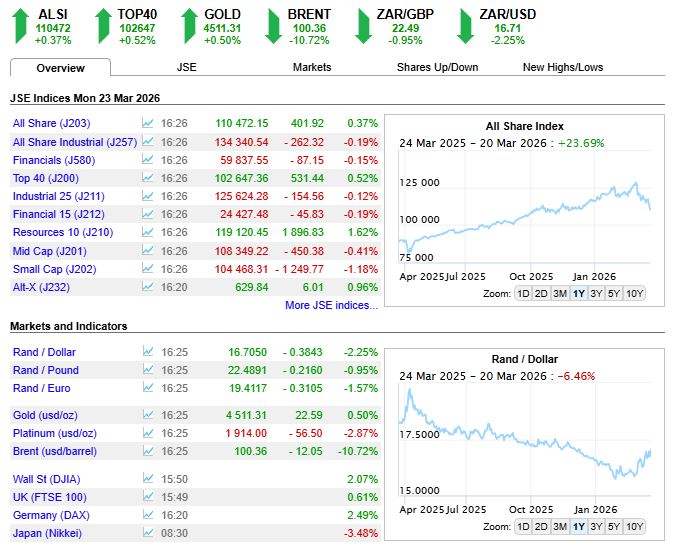
Gold plunges to 4-month low, rand weakens as war-driven inflation fears batter markets
Gold prices have come under intense pressure amid escalating geopolitical tensions in the Middle East, while the South African rand has weakened sharply as global investors retreat to safer assets. Read the full IOL Business Report article here>
Oil fluctuates as Trump’s Hormuz ultimatum fails to stir traders
Oil fluctuated near the highest close since mid-2022, as investors assessed President Donald Trump’s ultimatum to Iran to reopen the Strait of Hormuz and Tehran’s threat of more reprisals. Read the latest impact of the war on oil prices in Moneyweb here>
Markets without a safety net?
Investors are hanging on every word from Donald Trump who, true to form, continues to saturate the media landscape with pronouncements that are not always entirely consistent. Read the full Marketscreener article here>
Global shares slide, yields climb as Gulf war intensifies
Global shares slid on Monday while U.S. bond yields hit eight-month peaks as the U.S. and Iran traded escalating threats and Israel planned for “weeks” more fighting, sending oil prices on another roller-coaster ride. Read the latest from Reuters here>
When in doubt, zoom out
Markets have historically shown resilience during geopolitical and oil-related shocks. This chart tracks the long-term cumulative return of the S&P 500 across multiple oil crises since the 1970s. While short-term volatility is evident around major events, drawdowns have generally been temporary rather than structural and have not derailed long-term equity market growth.
While future market movements are uncertain, history shows that staying invested through disruption has been key to capturing long-term returns. Rather than trying to time market corrections, maintaining a disciplined long-term approach has consistently proven more effective.
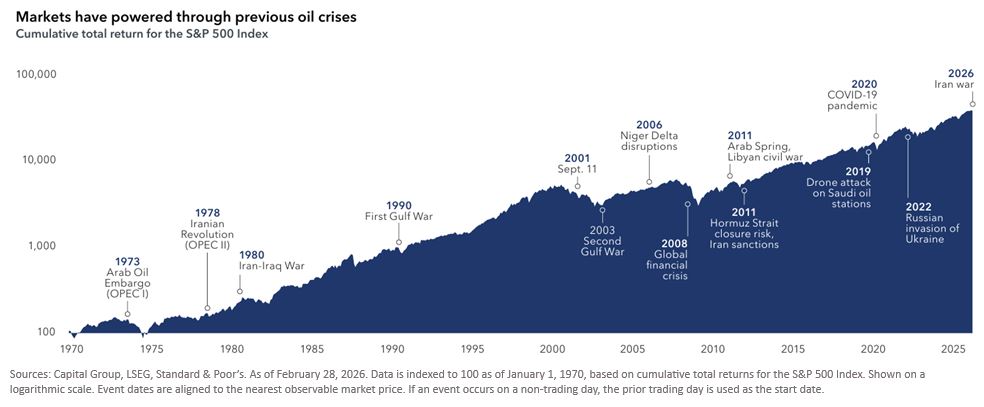
Thanks to Ninety One for this insightful look at the impact of oil on global markets..